

Three individuals pleaded guilty in federal district court in
Charleston, South Carolina, to trafficking more than $740,000 worth of
juvenile American eels aka “elvers” or “glass eels,” in violation of the
Lacey Act. Harry Wertan, Jr., Mark Weihe and Jay James each pleaded
guilty to selling or transporting elvers in interstate commerce, which
they had harvested illegally, or knew had been harvested illegally, in
South Carolina.
The pleas were the result of “Operation Broken Glass,” a
multi-jurisdiction U.S. Fish and Wildlife Service (USFWS) investigation
into the illegal trafficking of American eels. To date, the
investigation has resulted in guilty pleas for ten individuals whose
combined conduct resulted in the illegal trafficking of more than $2.6
million worth of elvers.
The guilty pleas were announced today by Assistant Attorney General
John C. Cruden for the Justice Department’s Environment and Natural
Resources Division, Acting U.S. Attorney Beth Drake for the District of
South Carolina, and Director Dan Ashe of the USFWS.
“We will not allow the rivers of the United States to be the poaching
grounds for international seafood markets,” said Assistant Attorney
General Cruden. “The American eel is an important but limited natural
and economic resource that must be protected. Trafficking only
undercuts the toil and honest efforts of those who obey the law.”
“This case underscores the role U.S. citizens often play in wildlife
trafficking and demonstrates that this deadly trade does not solely
impact large, charismatic mammals in distant countries,” said Director
Dan Ashe for USFWS. “U.S. Fish and Wildlife Service law enforcement
agents work tirelessly to save wildlife from the threat traffickers pose
here at home, and together with the Department of Justice, bring these
individuals to justice for their illegal activities.”
Eels are highly valued in east Asia for human consumption.
Historically, Japanese and European eels were harvested to meet this
demand; however, overfishing has led to a decline in the population of
these eels. As a result, harvesters have turned to the American eel to
fill the void resulting from the decreased number of Japanese and
European eels.
American eels spawn in the Sargasso Sea, an area of the North
Atlantic Ocean bounded on all sides by ocean currents. They then travel
as larvae from the Sargasso to the coastal waters of the eastern United
States, where they enter a juvenile or elver stage, swim upriver and
grow to adulthood in fresh water. Elvers are exported for aquaculture
in east Asia, where they are raised to adult size and sold for food.
Harvesters and exporters of American eels in the United States can sell
elvers to east Asia for more than $2000 per pound.
Because of the threat of overfishing, elver harvesting is prohibited
in the United States in all but three states: Maine, South Carolina and
Florida. Maine and South Carolina heavily regulate elver fisheries,
requiring that individuals be licensed and report all quantities of
harvested eels to state authorities. Although Florida does not have
specific elver-related regulations, the limited population of elvers in
Florida waters makes commercial eel fishing impossible.
“This investigation is an outstanding example of the dedication and
ingenuity shown by multiple agencies working together to expose and
curtail the illegal trade of American eels,” said Special
Agent-in-Charge Luis Santiago Southeast Region for USFWS. “Today’s pleas
are a success in our collective efforts to conserve and protect an
important American fishery.”
“Today’s pleas in the illegal trade of American Eels are a tremendous
step in preserving this important fishery,” said Colonel Chisolm
Frampton for the South Carolina Department of Natural Resources, Law
Enforcement Division. “A multitude of state and federal agencies did
outstanding work to bring this case to successful conclusion.”
The offenses in the case are felonies under the Lacey Act, each
carrying a maximum penalty of five years’ incarceration, a fine of up to
$250,000 or up to twice the gross pecuniary gain or loss, or both.
Operation Broken Glass was conducted by the USFWS and the Justice
Department’s Environmental Crimes Section in collaboration with the
Maine Marine Patrol, South Carolina Department of Natural Resources Law
Enforcement Division, New Jersey Division of Fish and Wildlife Bureau of
Law Enforcement, Connecticut Department of Energy and Environmental
Protection Conservation Police, Virginia Marine Resources Commission
Police, USFWS Refuge Law Enforcement, National Oceanic and Atmospheric
Administration Office of Law Enforcement, Massachusetts Environmental
Police, Rhode Island Department of Environmental Management Division of
Law Enforcement, New York State Environmental Conservation Police, New
Hampshire Fish and Game Division of Law Enforcement, Maryland Natural
Resources Police, North Carolina Wildlife Resource Commission Division
of Law Enforcement, Florida Fish and Wildlife Conservation Commission,
Yarmouth, Massachusetts Division of Natural Resources, North Myrtle
Beach, South Carolina Police Department and the Atlantic States Marine
Fisheries Commission.
Popular Posts
-
 In its simplest form, etiquette is nothing more than doing the right thing at the right time for a particular situation. Some of these ru...
 -
WASHINGTON – The U.S. Environmental Protection Agency (EPA) is launching a web-based discussion forum to gather public input on how the...
-
ASMFC Atlantic Menhaden Board Initiates Addendum to Increase Abundance and Spawning Stock Biomass Arlington, VA – The Commission’s Atlanti...
-
Alexandria, VA – The Commission’s Atlantic Striped Bass Management Board has initiated development of Draft Addendum III with the goals of r...
-
When you hire a guide on the Upper Delaware or anywhere else, don't make assumptions, check to see if your guide is licensed. On the...
-
Beginning February 1, 2014 the New York State Department of Environmental Conservation (DEC) is decreasing sporting license fees. This pric...
-
 It’s been an excellent water year so far and that's resulted in some very good drift boat fishing on the Upper Delaware. The Main Ste...
 -
Bill confirms outdoor recreation industry is a significant economic drive The bill, known as the Outdoor REC Act, passed the House...
-
 Summer Trout Fishing on the Upper Delaware River It’s been an excellent water year so far and that's resulted in some very good fish...
 -
Low, turbid water poses a risk to spawning trout Anglers: please don't fish the Esopus Creek from the Shandaken Portal to the Asho...
Tuesday, November 29, 2016


Wednesday, November 23, 2016
Delaware River Basin Commission Approves Drought Management Special Permit
Basin Placed in “Drought Watch” Stage Effective Immediately
The Delaware River Basin Commission (DRBC) at a
special meeting today issued a special permit for coordinated operation
of regional reservoirs, out-of-basin diversions, and Delaware River flow
objectives
in response to persistent dry conditions.
“The special permit unanimously approved today
provides for enhanced coordination of operations of regional reservoirs,
diversions, and flow objectives during the ongoing, extended period of
below-normal precipitation,” said DRBC Executive
Director Steve Tambini. “Today’s action also makes clear that the
entire basin is currently deemed to be in a ‘drought watch’ stage.”
The DRBC’s primary drought management objective,
which complements the basin states’ drought response efforts, is to
provide for conservation of regional reservoir storage for purposes of
water supply and flow augmentation in the Delaware
River and salinity control in the Delaware River Estuary.
The special permit issued today under section 10.4
of the compact that created the DRBC in 1961 provides a single set of
water resource management responses to address dry conditions both
“basinwide” and in the “lower basin,” which is the
portion of the basin downstream of Montague, N.J.
Under the special permit, the transition from one
possible drought stage to another – from “watch” to “warning” to
“drought” and back again to “normal” – will be based on the combined
storage in three reservoirs located in the Catskill
Mountains at the headwaters of the Delaware River in New York State.
Releases from these New York City reservoirs provide about half of the
city’s water supply and support a minimum flow target in the Delaware
River at Montague established by the U.S. Supreme
Court Decree of 1954. Combined storage in the three reservoirs is now
approximately 40% of capacity. In accordance with the provisions of
the compact, today’s resolution has also been unanimously approved by
the parties to the decree, which include Delaware,
New Jersey, Pennsylvania, New York State, and New York City.
Out-of-basin diversions to New York City and
portions of New Jersey established by the 1954 decree will be reduced
depending upon the drought stages defined by the special permit.
However, a reserve “bank” of water established by the decree
parties over the course of the past year in anticipation of a dry
period such as the current one will be available, allowing New Jersey to
minimize the effects of possible diversion reductions.
The Delaware River flow objective at Montague and a
second flow objective at Trenton, N.J. will also be reduced and will be
dependent on the location of the “salt line” in the Delaware River
Estuary if the basin enters into the most serious
“drought” stage of operations.
The purpose of the Trenton flow objective is to
control the movement of the “salt line” or “salt front” in the tidal
Delaware River. Adequate freshwater flowing downstream is needed to
repel the upstream advancement of “salty” or “brackish”
water from Delaware Bay to keep it away from drinking water intakes
serving residents in Philadelphia and New Jersey and industrial intakes
along the river.
“As of Nov. 20, the salt front is 19 river miles
upstream from its normal location for the month despite significant
freshwater reservoir releases,” said Tambini. “The current salt front
location is still 21 miles downstream of water supply
intakes in Pennsylvania and New Jersey.”
Under the “drought watch” stage operations
initiated today, several hydroelectric, recreation, and federal
reservoirs may be requested to either store or release water. In
addition, releases may be required from Merrill Creek Reservoir,
a facility in Warren County, N.J. constructed by a consortium of
electric utilities, to replace evaporative losses caused by power
generation.
The DRBC held a public hearing on Nov. 9 to solicit
public input on the persistent dry conditions throughout the basin and
how to address them, as required by the compact before being able to
take today’s action.
The below-normal precipitation totals throughout
most of the Delaware River Basin, with the resulting effects on
streamflows, groundwater levels, reservoir storage, and soil moisture,
have prompted New Jersey, Pennsylvania, and New York
to declare drought watches or warnings under their respective drought
operating plans in 36 of the 42 counties that lie entirely or partially
in the basin.
The DRBC is urging all water users to fully
cooperate with requests by the basin states to curb water use where
drought watches and warnings have been issued and is encouraging all
basin water users to maximize water efficiency wherever
possible. “Over 15 million people rely on waters of the Delaware River
Basin,” said Tambini. “During times of shortage, they also rely upon
coordinated action by the basin states, decree parties, and federal
government jointly through the DRBC to meet the
basin’s drought management objectives.”
The DRBC is a federal/interstate government agency
responsible for managing the water resources within the 13,539
square-mile Delaware River Basin without regard to political boundaries.
The five commission members are the governors of
the basin states (Delaware, New Jersey, New York, and Pennsylvania) and
the commander of the U.S. Army Corps of Engineers' North Atlantic
Division, who represents the federal government.
More information, including links to basin state
drought pages, updates about water resource conditions, and water
savings tips, can be found at
www.drbc.net.
Tuesday, November 22, 2016
Delaware River Basin Commission Is Holding A Special Drought Meeting
Meeting to be Held November 23, 2016 at 11 AM in DRBC's Goddard Room
DATE: The special meeting will take place on Wednesday, November 23, 2016 at 11:00 a.m. and is expected to last for less than one hour.
LOCATION: The meeting is open to the public and will take place in the Goddard Room of the Commission’s office building at 25 State Police Drive in West Trenton, New Jersey. Directions can be found at http://www.nj.gov/drbc/contact/directions/. Please note that web-based map applications do not provide reliable directions to DRBC’s office building.
SUPPLEMENTARY INFORMATION: The Commission will consider action pursuant to section 10.4 of the Delaware River Basin Compact, which would enable it to implement a coordinated response to dry conditions throughout the basin. In particular, the resolution would empower the Commission to provide for the conservation of regional reservoir storage through phased reductions in diversions, reservoir releases, and flow objectives for purposes of water supply and flow augmentation in the Delaware River and salinity control in the Delaware River Estuary.
In anticipation of the need to consider action under section 10.4, the Commission on November 9, 2016 conducted a public hearing on the persistent dry conditions throughout the basin and how to address them. There will be no opportunity for public comment at the special meeting on November 23.
The proposed resolution will be posted as soon as it becomes available. Reservoir storage and relevant drought related information is available via http://www.nj.gov/drbc/hydrological/drought/index.html
FOR FURTHER INFORMATION CONTACT: Pamela Bush, Commission Secretary and Assistant General Counsel, DRBC, at pamela.bush@drbc.nj.gov.
Monday, November 14, 2016
The Cold Facts on the ‘120-Degree Rule’
 You may have put your boat away for the season, but the occasional warm fall
day still brings plenty of paddlers out on the water. Knowing when to
wear the thermal protection offered by a dry- or wetsuit is key.
However, a long-assumed guideline meant to help paddlers make the right
decision, sometimes known as the “120-degree rule,” may instead put
paddlers in danger.
You may have put your boat away for the season, but the occasional warm fall
day still brings plenty of paddlers out on the water. Knowing when to
wear the thermal protection offered by a dry- or wetsuit is key.
However, a long-assumed guideline meant to help paddlers make the right
decision, sometimes known as the “120-degree rule,” may instead put
paddlers in danger.
The 120-degree rule adds the air and water
temperatures to determine when thermal protection is required. It
assumes that if the total is above 120 F, that no dry- or wet-suit is
needed.
“Using this simple formula,” says BoatUS Foundation Assistant Director of Boating Safety Ted Sensenbrenner, “a paddler could mistakenly believe that if air temperature is the low 70s and water temperature is hovering around the low 50s, that thermal protection is not necessary. That could not be farther from the truth.”
Sensenbrenner says that warm fall or spring days give paddlers a false sense of security. “Water temperatures have plunged, but the warm sun on your face hides the reality that accidentally going overboard at this time of year could quickly lead to trouble.”
According to research, sudden cold-water immersion can kill in several ways: involuntary gasp reflex and hyperventilation, cold incapacitation, and immersion hypothermia. Not wearing a life jacket compounds the drowning risk.
A word to the wise? “Always wear a life jacket when in an open boat or on deck, and consider the water temperature when dressing for your next boating adventure,” says Sensenbrenner. For more on cold-water boating including what to wear, go to BoatUS.org/cold-water-boating.
Friday, November 04, 2016
New York DEC Emergency Regulation Prohibits Fishing for All Species in Sections of the Esopus Creek & Ashokan Reservoir:
Emergency Regulations Prohibit Fishing from 11/4/16 until 1/31/17
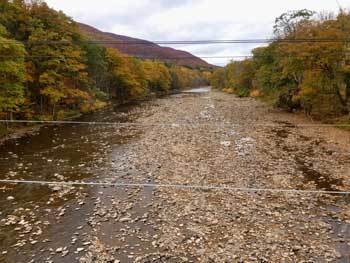
Effective 11/2/16, a new DEC Emergency Regulation prohibits fishing for all species in the following sections of the upper Esopus creek and Ashokan reservoir:
- from the Shandaken Tunnel outlet in Allaben, to a downstream boundary in the Ashokan Reservoir from the mouth of Traver Hollow stream due east to the old railroad causeway (see attached PDF for map of area affected by the regulation).
This Emergency Regulation is in effect until January 31, 2107.
Due to prolonged dry conditions, the Esopus Creek and its tributary streams are experiencing very low water flow, creating a stressful environment for trout. Additional stress on these fish from angling may impact their ability to spawn and produce the next generation of trout.
Thursday, November 03, 2016
Three Salmon Poachers Arrested After Early-Morning Chase
Three men suspected of poaching during the annual salmon run were
arrested the morning of November 2, after leading police on a wild chase in
the woods in Niagara County.
The incident occurred just after 2 a.m. when DEC Environmental Conservation Officers (ECOs) were conducting a night patrol along the Lake Ontario shoreline and its tributaries.
ECOs Roger Ward and Nathan Ver Hague were checking the Burt Dam area of 18-mile Creek in Newfane when they noticed several large garbage bags piled on a pathway. The officers inspected the bags and found them loaded with freshly caught salmon.
At the same time, a pickup truck slowly drove by the area. Two men approached on foot and ECO Ward revealed himself and ordered the men to stop. The men took off running through the woods. ECO Ward apprehended one suspect hiding in the brush, but as ECO Ver Hague chased the other down to the creek, the man dove in and swam off. The Niagara County Sheriff's Department was called for assistance.
Deputy Matt Grainge responded and located a pickup truck a short distance away matching the description given by the ECOs. The driver was sitting inside awaiting a call from the other two men.
Deputies Keith Hetrick, John Vosberg and a K-9 officer tracked the suspect who swam across the creek and eventually located him attempting to climb up a gorge. He was taken into custody.
A total of 69 salmon ranging in size from 5 to 35 pounds had been poached from the creek, the subjects using a weighted treble hook and net to snag the fish.
The three men - Sergey Yatchuk, 41, of 55 Applewood Ln., Getzville, Petro Parfenyk, 29, of 2204 Prospect Ave., Erie, Penn., and Mikhail F. Sakalosh, 39, of 8322 Taylor Colquitt Rd., Spartanburg, S.C. - were charged with 32 violations, including fishing without a license, possessing foul-hooked fish, taking fish by snatching, taking fish in excess of daily limit, and illegal fishing at night.
The three suspects were remanded to the county jail in lieu of bail, $1,100 for Parfenyk and Sakalosh and $1,000 for Yatchuk.
The incident occurred just after 2 a.m. when DEC Environmental Conservation Officers (ECOs) were conducting a night patrol along the Lake Ontario shoreline and its tributaries.
ECOs Roger Ward and Nathan Ver Hague were checking the Burt Dam area of 18-mile Creek in Newfane when they noticed several large garbage bags piled on a pathway. The officers inspected the bags and found them loaded with freshly caught salmon.
At the same time, a pickup truck slowly drove by the area. Two men approached on foot and ECO Ward revealed himself and ordered the men to stop. The men took off running through the woods. ECO Ward apprehended one suspect hiding in the brush, but as ECO Ver Hague chased the other down to the creek, the man dove in and swam off. The Niagara County Sheriff's Department was called for assistance.
Deputy Matt Grainge responded and located a pickup truck a short distance away matching the description given by the ECOs. The driver was sitting inside awaiting a call from the other two men.
Deputies Keith Hetrick, John Vosberg and a K-9 officer tracked the suspect who swam across the creek and eventually located him attempting to climb up a gorge. He was taken into custody.
A total of 69 salmon ranging in size from 5 to 35 pounds had been poached from the creek, the subjects using a weighted treble hook and net to snag the fish.
The three men - Sergey Yatchuk, 41, of 55 Applewood Ln., Getzville, Petro Parfenyk, 29, of 2204 Prospect Ave., Erie, Penn., and Mikhail F. Sakalosh, 39, of 8322 Taylor Colquitt Rd., Spartanburg, S.C. - were charged with 32 violations, including fishing without a license, possessing foul-hooked fish, taking fish by snatching, taking fish in excess of daily limit, and illegal fishing at night.
The three suspects were remanded to the county jail in lieu of bail, $1,100 for Parfenyk and Sakalosh and $1,000 for Yatchuk.
Friday, October 21, 2016
Seven Men Plead Guilty for Illegally Harvesting and Selling American Eels
Between
the dates of October 4 and October 6, seven individuals pleaded guilty
in Federal District Court in Portland, Maine, to trafficking more than
$1.9 million worth of juvenile American eels, also known as “elvers,” in
violation of the Lacey Act.
Yarann Im, Mark Green, John Pinkham, Thomas Reno, Michael Bryant and George Anestis each pleaded guilty to selling or transporting elvers in interstate commerce, that they had harvested illegally, or knew had been harvested illegally, in various East Coast states, including Virginia, New Jersey, Massachusetts, and Rhode Island, among others. Thomas Choi pleaded guilty to exporting elvers that he knew had been harvested illegally in New Jersey, Massachusetts, and elsewhere.
The guilty pleas were announced today by Assistant Attorney General John C. Cruden for the Justice Department’s Environment and Natural Resources Division and Director Dan Ashe of the United States Fish and Wildlife Service (USFWS). The pleas were the result of “Operation Broken Glass,” a multi-jurisdiction USFWS investigation into the illegal trafficking of American eels.
“Without the robust enforcement of our nation’s wildlife laws, trafficking in species like the protected American eel will undermine vital marine resources to the point of no return,” said Assistant Attorney General John C. Cruden for the Justice Department’s Environment and Natural Resources Division. “The American eel is a unique and economically important species in river systems along the U.S. east coast. These convictions should send a strong message that we will investigate and prosecute poaching as a serious crime, standing side by side with our state law enforcement partners.”
“Skyrocketing prices for juvenile American eels in Asia have led to a surge in poaching and trafficking in this unique species, threatening to wipe it out in the rivers of the Northeast,” said Director Ashe. “The prosecution of these poachers demonstrates our resolve to work with our state and federal law enforcement partners to halt illegal trade in American eels and sustain the species for future generations. The success and scope of Operation Broken Glass would not have been possible without this unparalleled collaboration, which will serve as a model for future investigations.”
“Elver landings are one of Maine’s largest revenue producing marine resources,” said Maine Marine Patrol Colonel Jon Cornish. “Strong enforcement of both state and federal statutes are a key to the success of this fishery. Maine Marine Patrol is proud to have been a participant within Operation Broken Glass. These cases represent the results of what can be accomplished when agencies partner effectively.”
“This investigation is an example of excellent collaboration between wildlife law enforcement agencies at the federal, state, and local level,” said Assistant Administrator Eileen Sobeck of NOAA Fisheries. “NOAA’s Office of Law Enforcement will continue to support investigations to ensure that those fishermen who obey the rules reap the benefits of fair competition and those who do not are caught and justice served.”
“The waters of New Jersey provide ideal conditions for migrating juvenile American eels,” said Director Dave Chanda of the New Jersey Department of Environmental Protection’s Division of Fish &Wildlife. “Despite laws banning American eel harvest, New Jersey continues to experience pressure from those looking to illegally target this highly desired resource to meet overseas demand. In their pursuit of financial gain, these individuals demonstrated deliberate indifference to the health and viability of our state's natural resource.”
Eels are highly valued in east Asia for human consumption. Historically, Japanese and European eels were harvested to meet this demand; however, overfishing has led to a decline in the population of these eels. As a result, harvesters have turned to the American eel to fill the resulting void.
American eels spawn in the Sargasso Sea, an area of the North Atlantic Ocean bounded on all sides by ocean currents. They then travel as larvae from the Sea to the coastal waters of the eastern United States, where they enter a juvenile or elver stage, swim upriver and grow to adulthood in fresh water. Elvers are exported for aquaculture in east Asia, where they are raised to adult size and sold for food. Harvesters and exporters of American eels in the United States can sell elvers to east Asian buyers for more than $2000 per pound.
Because of the threat of overfishing, elver harvesting is prohibited in the United States in all but three states: Maine, South Carolina and Florida. Maine and South Carolina heavily regulate elver fisheries, requiring that individuals be licensed and report all quantities of harvested eels to state authorities.
Although Florida does not have specific elver-related regulations, the limited population of elvers in Florida waters makes commercial elver fishing impossible.
The seven defendants all illegally harvested, sold, transported, or exported elvers, knowing they had been harvested in violation of state law. Further, as a means of concealing the illegal sale and export of elvers, the defendants used Maine or Florida eel harvest licenses, whether theirs or someone else’s, to claim in required paperwork that the elvers were obtained legally from Maine or Florida waters.
Elver export declaration packages submitted to the USFWS included this false documentation in order to disguise the illegal origins of the elvers and to facilitate their export from the United States to buyers in east Asia.
The offenses in the case are felonies under the Lacey Act, each carrying a maximum penalty of five years’ incarceration, a fine of up to $250,000 or up to twice the gross pecuniary gain or loss, or both.
Operation Broken Glass was conducted by the USFWS and the Justice Department’s Environmental Crimes Section in collaboration with the Maine Marine Patrol, South Carolina Department of Natural Resources Law Enforcement Division, New Jersey Division of Fish and Wildlife Bureau of Law Enforcement, Connecticut Department of Energy and Environmental Protection Conservation Police, Virginia Marine Resources Commission Police, USFWS Refuge Law Enforcement, National Oceanic and Atmospheric Administration Office of Law Enforcement, Massachusetts Environmental Police, Rhode Island Department of Environmental Management Division of Law Enforcement, New York State Environmental Conservation Police, New Hampshire Fish and Game Division of Law Enforcement, Maryland Natural Resources Police, North Carolina Wildlife Resource Commission Division of Law Enforcement, Florida Fish and Wildlife Conservation Commission, Yarmouth, MA Division of Natural Resources, North Myrtle Beach, SC Police Department and the Atlantic States Marine Fisheries Commission.
The government is represented by Environmental Crimes Section Trial Attorneys Cassandra Barnum and Shane Waller.
Yarann Im, Mark Green, John Pinkham, Thomas Reno, Michael Bryant and George Anestis each pleaded guilty to selling or transporting elvers in interstate commerce, that they had harvested illegally, or knew had been harvested illegally, in various East Coast states, including Virginia, New Jersey, Massachusetts, and Rhode Island, among others. Thomas Choi pleaded guilty to exporting elvers that he knew had been harvested illegally in New Jersey, Massachusetts, and elsewhere.
The guilty pleas were announced today by Assistant Attorney General John C. Cruden for the Justice Department’s Environment and Natural Resources Division and Director Dan Ashe of the United States Fish and Wildlife Service (USFWS). The pleas were the result of “Operation Broken Glass,” a multi-jurisdiction USFWS investigation into the illegal trafficking of American eels.
“Without the robust enforcement of our nation’s wildlife laws, trafficking in species like the protected American eel will undermine vital marine resources to the point of no return,” said Assistant Attorney General John C. Cruden for the Justice Department’s Environment and Natural Resources Division. “The American eel is a unique and economically important species in river systems along the U.S. east coast. These convictions should send a strong message that we will investigate and prosecute poaching as a serious crime, standing side by side with our state law enforcement partners.”
“Skyrocketing prices for juvenile American eels in Asia have led to a surge in poaching and trafficking in this unique species, threatening to wipe it out in the rivers of the Northeast,” said Director Ashe. “The prosecution of these poachers demonstrates our resolve to work with our state and federal law enforcement partners to halt illegal trade in American eels and sustain the species for future generations. The success and scope of Operation Broken Glass would not have been possible without this unparalleled collaboration, which will serve as a model for future investigations.”
“Elver landings are one of Maine’s largest revenue producing marine resources,” said Maine Marine Patrol Colonel Jon Cornish. “Strong enforcement of both state and federal statutes are a key to the success of this fishery. Maine Marine Patrol is proud to have been a participant within Operation Broken Glass. These cases represent the results of what can be accomplished when agencies partner effectively.”
“This investigation is an example of excellent collaboration between wildlife law enforcement agencies at the federal, state, and local level,” said Assistant Administrator Eileen Sobeck of NOAA Fisheries. “NOAA’s Office of Law Enforcement will continue to support investigations to ensure that those fishermen who obey the rules reap the benefits of fair competition and those who do not are caught and justice served.”
“The waters of New Jersey provide ideal conditions for migrating juvenile American eels,” said Director Dave Chanda of the New Jersey Department of Environmental Protection’s Division of Fish &Wildlife. “Despite laws banning American eel harvest, New Jersey continues to experience pressure from those looking to illegally target this highly desired resource to meet overseas demand. In their pursuit of financial gain, these individuals demonstrated deliberate indifference to the health and viability of our state's natural resource.”
Eels are highly valued in east Asia for human consumption. Historically, Japanese and European eels were harvested to meet this demand; however, overfishing has led to a decline in the population of these eels. As a result, harvesters have turned to the American eel to fill the resulting void.
American eels spawn in the Sargasso Sea, an area of the North Atlantic Ocean bounded on all sides by ocean currents. They then travel as larvae from the Sea to the coastal waters of the eastern United States, where they enter a juvenile or elver stage, swim upriver and grow to adulthood in fresh water. Elvers are exported for aquaculture in east Asia, where they are raised to adult size and sold for food. Harvesters and exporters of American eels in the United States can sell elvers to east Asian buyers for more than $2000 per pound.
Because of the threat of overfishing, elver harvesting is prohibited in the United States in all but three states: Maine, South Carolina and Florida. Maine and South Carolina heavily regulate elver fisheries, requiring that individuals be licensed and report all quantities of harvested eels to state authorities.
Although Florida does not have specific elver-related regulations, the limited population of elvers in Florida waters makes commercial elver fishing impossible.
The seven defendants all illegally harvested, sold, transported, or exported elvers, knowing they had been harvested in violation of state law. Further, as a means of concealing the illegal sale and export of elvers, the defendants used Maine or Florida eel harvest licenses, whether theirs or someone else’s, to claim in required paperwork that the elvers were obtained legally from Maine or Florida waters.
Elver export declaration packages submitted to the USFWS included this false documentation in order to disguise the illegal origins of the elvers and to facilitate their export from the United States to buyers in east Asia.
The offenses in the case are felonies under the Lacey Act, each carrying a maximum penalty of five years’ incarceration, a fine of up to $250,000 or up to twice the gross pecuniary gain or loss, or both.
Operation Broken Glass was conducted by the USFWS and the Justice Department’s Environmental Crimes Section in collaboration with the Maine Marine Patrol, South Carolina Department of Natural Resources Law Enforcement Division, New Jersey Division of Fish and Wildlife Bureau of Law Enforcement, Connecticut Department of Energy and Environmental Protection Conservation Police, Virginia Marine Resources Commission Police, USFWS Refuge Law Enforcement, National Oceanic and Atmospheric Administration Office of Law Enforcement, Massachusetts Environmental Police, Rhode Island Department of Environmental Management Division of Law Enforcement, New York State Environmental Conservation Police, New Hampshire Fish and Game Division of Law Enforcement, Maryland Natural Resources Police, North Carolina Wildlife Resource Commission Division of Law Enforcement, Florida Fish and Wildlife Conservation Commission, Yarmouth, MA Division of Natural Resources, North Myrtle Beach, SC Police Department and the Atlantic States Marine Fisheries Commission.
The government is represented by Environmental Crimes Section Trial Attorneys Cassandra Barnum and Shane Waller.
Thursday, October 20, 2016
2016 Expansion of Hunting and Fishing Opportunities on National Wildlife Refuges
U.S. Fish and Wildlife Service announced the
agency will expand fishing and hunting opportunities on 13 refuges
throughout the Service’s National Wildlife Refuge System.
The final rule also modifies existing refuge-specific regulations on
more than 70 other refuges and wetland management districts. This
includes migratory bird, upland game and big game hunting, and sport
fishing
.
In Colorado, hunting for elk will occur for the first time in designated areas of Baca National Wildlife Refuge, as well as in expanded areas of Alamosa National Wildlife Refuge and Monte Vista National Wildlife Refuge.
“Sportsmen and sportswomen were among the first to champion wildlife protection. Their efforts are the backbone of the North American Wildlife Conservation Model — fish and wildlife belong to all Americans, and they need to be managed in a way that will sustain their populations forever,” said Director Dan Ashe. “We are pleased to offer new opportunities for the continuance of a hunting and fishing tradition that is in accordance with sustainable recreational use in the National Wildlife Refuge System.”
The final rule also includes opening sport fishing of state-regulated species for the first time at Lake Andes National Wildlife Refuge in South Dakota, and expanding areas available for sport fishing at Patoka River National Wildlife Refuge in Indiana.
The Service is responsible for managing more than 850 million acres in the Refuge System, including five marine national monuments, 565 national wildlife refuges and 38 wetland management districts. The agency manages hunting and fishing programs to ensure sustainable wildlife populations, and other forms of wildlife-dependent recreation on refuges, such as wildlife watching and photography.
In addition, the Service’s Urban Wildlife Conservation Program, launched in 2013, offers opportunities for residents of America’s cities to learn about and take part in wildlife conservation.
There is a national wildlife refuge within an hour’s drive from most major metropolitan areas.
Hunting, fishing and other outdoor activities contributed more than $144.7 billion in economic activity across the United States according to the Service’s National Survey of Fishing, Hunting and Wildlife-Associated Recreation, published every five years. More than 90 million Americans, or 41 percent of the United States’ population age 16 and older, pursue wildlife-related recreation. The Service’s report Banking on Nature shows that refuges pump $2.4 billion into the economy and support more than 35,000 jobs. More than 48 million visits are made to refuges every year.
“Hunting and fishing give families a chance to carry on traditions that they have celebrated for generations,” Ashe added. “These types of recreation also benefit local economies and generate much needed additional funding for wildlife conservation by bringing people into national wildlife refuges, as well as provide an important connection between people and the outdoors.”
The Service’s final rule opens the following refuge to hunting for the first time:
Colorado
South Dakota
Colorado
Under the National Wildlife Refuge System Improvement Act of 1997, the Service permits hunting and fishing along with four other types of wildlife-dependent recreation, including wildlife photography, environmental education, wildlife observation and interpretation, when they are compatible with an individual refuge’s purpose and mission. Hunting, within specified limits, is now permitted on 337 wildlife refuges. Fishing is now permitted on 276 wildlife refuges.
.
In Colorado, hunting for elk will occur for the first time in designated areas of Baca National Wildlife Refuge, as well as in expanded areas of Alamosa National Wildlife Refuge and Monte Vista National Wildlife Refuge.
“Sportsmen and sportswomen were among the first to champion wildlife protection. Their efforts are the backbone of the North American Wildlife Conservation Model — fish and wildlife belong to all Americans, and they need to be managed in a way that will sustain their populations forever,” said Director Dan Ashe. “We are pleased to offer new opportunities for the continuance of a hunting and fishing tradition that is in accordance with sustainable recreational use in the National Wildlife Refuge System.”
The final rule also includes opening sport fishing of state-regulated species for the first time at Lake Andes National Wildlife Refuge in South Dakota, and expanding areas available for sport fishing at Patoka River National Wildlife Refuge in Indiana.
The Service is responsible for managing more than 850 million acres in the Refuge System, including five marine national monuments, 565 national wildlife refuges and 38 wetland management districts. The agency manages hunting and fishing programs to ensure sustainable wildlife populations, and other forms of wildlife-dependent recreation on refuges, such as wildlife watching and photography.
In addition, the Service’s Urban Wildlife Conservation Program, launched in 2013, offers opportunities for residents of America’s cities to learn about and take part in wildlife conservation.
There is a national wildlife refuge within an hour’s drive from most major metropolitan areas.
Hunting, fishing and other outdoor activities contributed more than $144.7 billion in economic activity across the United States according to the Service’s National Survey of Fishing, Hunting and Wildlife-Associated Recreation, published every five years. More than 90 million Americans, or 41 percent of the United States’ population age 16 and older, pursue wildlife-related recreation. The Service’s report Banking on Nature shows that refuges pump $2.4 billion into the economy and support more than 35,000 jobs. More than 48 million visits are made to refuges every year.
“Hunting and fishing give families a chance to carry on traditions that they have celebrated for generations,” Ashe added. “These types of recreation also benefit local economies and generate much needed additional funding for wildlife conservation by bringing people into national wildlife refuges, as well as provide an important connection between people and the outdoors.”
The Service’s final rule opens the following refuge to hunting for the first time:
Colorado
- Baca National Wildlife Refuge: Open migratory game bird hunting, upland game hunting and big game hunting. The refuge is currently closed to other public use activities.
South Dakota
- Lake Andes National Wildlife Refuge: Open sport fishing. The refuge is already open to migratory game bird hunting, upland game hunting and big game hunting.
Colorado
- Alamosa National Wildlife Refuge: Expand migratory game bird hunting and open big game hunting. The refuge is already open to migratory game bird hunting and upland game hunting.
- Monte Vista National Wildlife Refuge: Expand migratory game bird hunting and open big game hunting. The refuge is already open to migratory game bird hunting and upland game hunting.
- Patoka River National Wildlife Refuge and Management Area: Expand migratory game bird hunting, upland game hunting, big game hunting and sport fishing. The refuge is already open to migratory game bird hunting, upland game hunting, big game hunting and sport fishing.
- Atchafalaya National Wildlife Refuge: Expand big game hunting. The refuge is already open to migratory game bird hunting, upland game hunting, big game hunting and sport fishing.
- Black Bayou Lake National Wildlife Refuge: Expand migratory game bird hunting, upland game hunting and big game hunting. The refuge is already open to migratory game bird hunting, upland game hunting, big game hunting and sport fishing.
- Detroit River International Wildlife Refuge: Expand migratory game bird hunting, upland game hunting and big game hunting. The refuge is already open to migratory game bird hunting, upland game hunting and big game hunting.
- Montezuma National Wildlife Refuge: Expand migratory game bird hunting and big game hunting. The refuge is already open to migratory game bird hunting, big game hunting and sport fishing.
- Washita National Wildlife Refuge: Expand big game hunting. The refuge is already open to migratory game bird hunting, upland game hunting, big game hunting and sport fishing.
- Waccamaw National Wildlife Refuge: Expand migratory game bird hunting, upland game hunting and big game hunting. The refuge is already open to migratory game bird hunting, upland game hunting, big game hunting and sport fishing.
- Anahuac National Wildlife Refuge: Expand migratory game bird hunting. The refuge is already open to migratory game bird hunting and sport fishing.
- Buffalo Lake National Wildlife Refuge: Open big game hunting. The refuge is already open to upland game hunting.
Under the National Wildlife Refuge System Improvement Act of 1997, the Service permits hunting and fishing along with four other types of wildlife-dependent recreation, including wildlife photography, environmental education, wildlife observation and interpretation, when they are compatible with an individual refuge’s purpose and mission. Hunting, within specified limits, is now permitted on 337 wildlife refuges. Fishing is now permitted on 276 wildlife refuges.
Monday, October 17, 2016
Anglers asked not to fish Esopus between Shandaken Portal and the Ashokan Reservoir
Low, turbid water poses a risk to spawning trout
Anglers: please don't fish the Esopus Creek from the Shandaken Portal to the Ashokan Reservoir. (see attached map for area in question).
If you live near, or fish this section of the Esopus, you have no doubt noticed how low the water level is and how brown and silt-laden the water is.
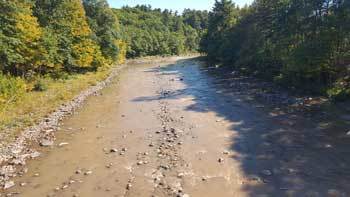
Water from the Schoharie Reservoir feeds into the Esopus via the Shandaken Portal. Drought has drastically reduced water levels in the Schoharie Reservoir and last Friday, DEC decided to cut back on the water entering the Esopus through the portal.
DEC Fisheries staff are concerned that the muddy flow from the Portal would hurt the stream ecosystem and threaten trout spawning which will soon be underway.
As a result, water levels in the Esopus, which were already low, will drop further. Fish in the Creek could be very vulnerable to anglers and natural predators. Nonetheless, DEC staff believe that the trout will be better off than if they try to spawn in mud-laden water.
DEC will continue to monitor conditions in the creek. We anticipate that Emergency Regulations will be issued soon that will temporarily prohibit fishing in the Esopus downstream of the portal to the Ashokan Reservoir. We'll let you know when this happens.
Wednesday, August 24, 2016
NY DEC Announces Proposed Changes to Freshwater Sportfishing Regulations
Public Comments Accepted Through October 7, 2016
Regulations to be Effective April 2017
The New York State Department of Environmental Conservation (DEC) is accepting comments on proposed changes to freshwater fishing regulations through October 7, 2016, Commissioner Basil Seggos announced today.DEC modifies freshwater sportfishing regulations approximately every two years as part of DEC's commitment to enhance fishing opportunities and protect the State's freshwater resources.
"New York provides some of the best fishing in the nation, and the continuous assessment and modification of sportfishing regulations ensure that this remains the case for generations to come," said Commissioner Seggos. "I encourage anglers to review what is being proposed and provide input during the public comment period."
DEC assessed the status of existing freshwater sportfish populations and the desires of anglers in developing these proposed regulations. Many of the proposed changes are the result of an effort to consolidate regulations and eliminate special regulations that are no longer warranted or have become outdated. The new freshwater sportfishing regulations are scheduled to take effect on April 1, 2017. Once enacted, the new regulations will be included in the 2017-18 Freshwater Fishing Regulations Guide.
The proposed regulations were first provided for informal public review on the DEC website in February 2016. The early feedback helped DEC determine which regulation changes to advance or eliminate.
Comments on the proposed regulations should be sent by email to regulations.fish@dec.ny.gov or mailed to Gregory Kozlowski, New York State Department of Environmental Conservation, Bureau of Fisheries, 625 Broadway, Albany, NY 12233-4753.
The full text of the proposed regulations are also available on DEC's website. The proposed changes include:
Great Lakes Proposals:
- Clarify that St. Lawrence River tributaries in Franklin and Clinton counties are exempt from Great Lakes regulations.
- Define the portion of Cattaraugus Creek subject to Lake Erie and tributary fishing regulations from Lake Erie upstream to the Springville Dam.
- Expand the Lake Erie and tributaries 20-inch minimum size limit one fish daily limit black bass regulation to December 1 through the Friday before the third Saturday in June.
- Improved language for interpreting combined trout and salmon creel limit in Lake Ontario.
- Reduce the daily limit from five to three northern pike for St. Lawrence River and define boundary between Lake Ontario and the St. Lawrence River.
- Clarification of boundary between Lake Ontario and the Salmon River.
- Provide an exception allowing access for fishing to the closed section of the Salmon River on Salmon River Hatchery property by permit.
Walleye, black bass and northern pike proposals:
- Establish an 18-inch minimum size limit and daily creel limit of three walleye for Titicus Reservoir (Westchester County); Sacandaga Lake and tributaries and outlet and Lake Pleasant and tributaries (Hamilton County); Kiwassa Lake, St. Regis Falls Impoundment, and Little Wolf Pond (Franklin County); Putnam Pond (Essex County); Cazenovia and DeRuyter lakes (Madison County); Waterport Reservoir (Orleans County); Rio Reservoir (Orange and Sullivan counties); East Sidney Reservoir (Delaware County); Taghkanic Lake (Columbia County); Canadarago Lake (Otsego County); and additional portions of the Seneca River (Cayuga, Onondaga, Seneca and Wayne counties).
- Eliminate 18-inch minimum size limit and daily creel limit of three walleye in Chautauqua Lake (Chautauqua County) and Franklin Falls Flow (Essex County).
- Clarify that the 22-inch minimum size five fish daily limit for northern pike regulation applies to the Wayne County portion of the Seneca River.
- Clarify that statewide black bass regulations apply to the Hamilton County portion of Fourth Lake.
- Eliminate the special regulation for black bass in the Hamilton County portion of the Hudson River.
Trout and salmon proposals:
- Decrease the minimum size limit for trout at Colgate Lake (Greene County) from 12 to 9 inches.
- Eliminate special trout regulation on Whey Pond (Franklin County).
- Eliminate the special regulation for landlocked salmon for Piseco Lake (Hamilton County).
- Decrease the minimum size length for lake trout in Woodhull Lake (Herkimer County) from 21 to 18 inches.
- Change the end time anglers are allowed to fish Spring Creek on the Caledonia State Fish Hatchery property from 4:00 PM to 3:30 PM.
- Eliminate the 9-inch minimum size limit for trout in the Carmans River (Suffolk County) in Southaven County Park as well as the catch and release section of the Carmans River for brown and rainbow trout.
- Reduce the number of brown trout and rainbow trout that can be kept as part of a five fish daily limit in Skaneateles Lake to no more than three of either species.
- Reduce the allowable daily harvest of brown trout and rainbow trout from five of each to three of each and increase the allowable daily harvest of lake trout from three to five as part of the five in any combination daily limit regulation for trout, lake trout, and landlocked salmon at Cayuga and Owasco lakes.
- Increase the minimum size limit for rainbow trout from 9 to 15 inches at Owasco, Skaneateles and Otisco Lake tributaries.
Gear and use of gear proposals:
- Eliminate the allowance for spearing bullheads and suckers in all Cayuga, Oswego and Wayne county tributaries to Lake Ontario.
- Allow for the taking of suckers by snatching (but not blind snatching) from January 1 through March 15 in specific portions of the Otselic and Tioughnioga rivers in Cortland County.
- Eliminate the allowance for lake whitefish snatching and blind snatching at Piseco Lake in Hamilton County.
- Continue to restrict the number of devices allowed for ice fishing on Bigsby and Copperas ponds (Essex County), Upper Saranac Lake (Franklin County), and Fawn Lake (Hamilton County).
- Allow for ice fishing in Rushford Lake in Allegany County.
- Re-open Crane Pond (Essex County) to ice fishing.
Baitfish and non-game fish proposals:
- Remove the prohibition on the use or possession of smelt in Lake George and allow for harvest of smelt by angling.
- Clarify that taking and possessing sauger and mooneye is prohibited in Lake Champlain.
Fishing prohibited proposals:
- Prohibit fishing at any time on Buttermilk Creek from mouth to Fox Valley Road Bridge.
- Close two short sections of Fish Creek and Indian River in St. Lawrence County to fishing from March 16 until the opening of walleye season.
- Close a section of the Grasse River in St. Lawrence County to all fishing from March 16 until the opening of walleye season.
- Clarify the portion of the Bouquet River that is closed to fishing at any time.
- Eliminate the angling and dipnetting prohibited regulation on Dutch Hollow Brook in Cayuga County.
Subscribe to:
Posts (Atom)